5. Infection (Bacterial, Viral, Fungal, Tuberculosis)
Definition
Respiratory infections involve inflammation of lung tissue due to pathogenic microorganisms, typically categorised as:
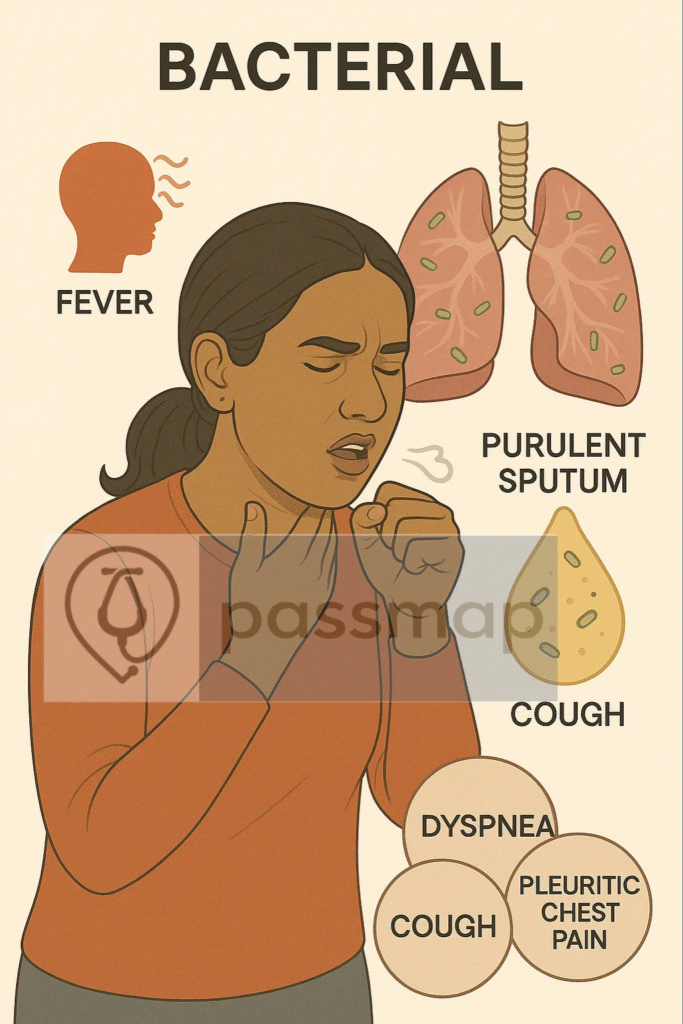
Bacterial (e.g. Streptococcus pneumoniae, Haemophilus influenzae)
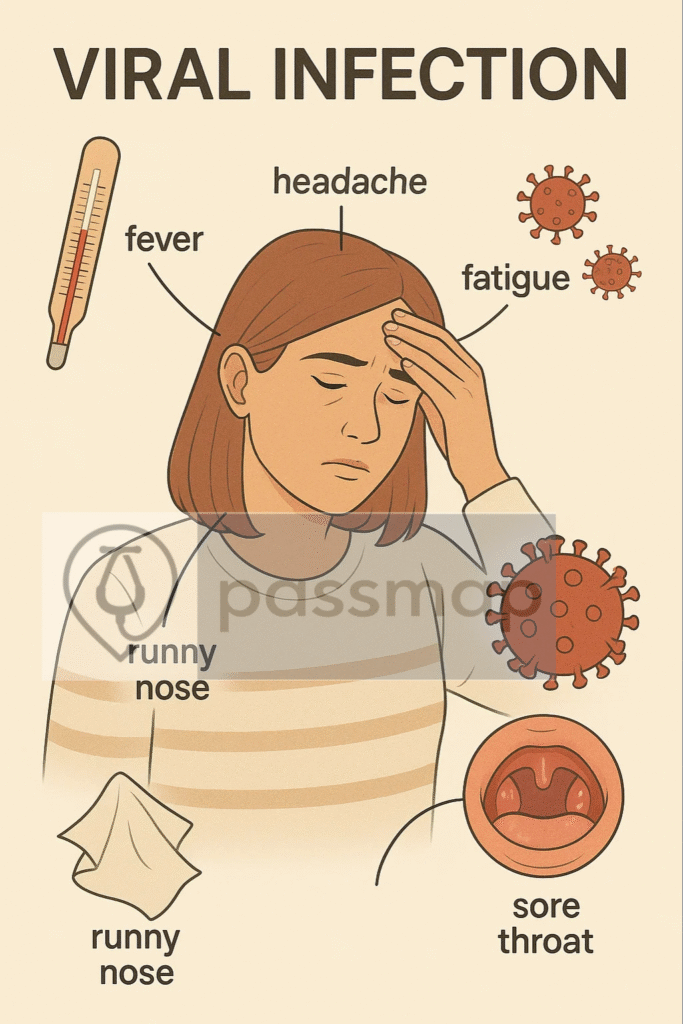
Viral (e.g. Influenza, RSV, COVID-19)
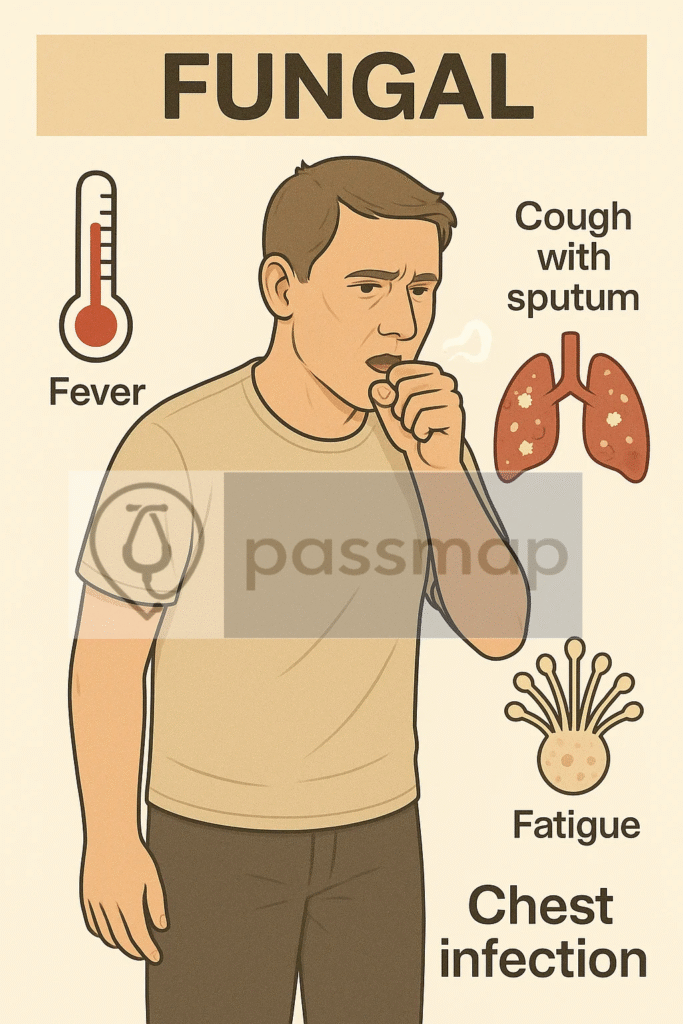
Fungal (e.g. Aspergillus, Pneumocystis jirovecii)
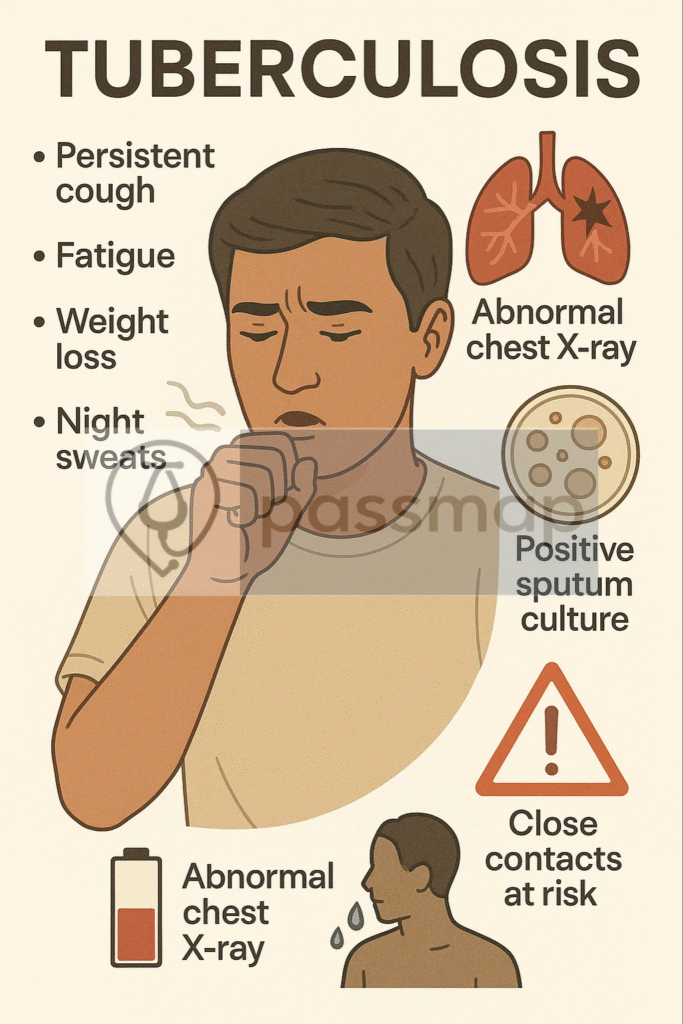
Mycobacterial (Tuberculosis โ Mycobacterium tuberculosis)
๐ฏ EXAM ANCHOR โ CORE CONCEPT (PARA)
Respiratory infection = lung inflammation due to pathogenic organisms
Classified as bacterial, viral, fungal, or mycobacterial (TB)
๐ PARA commonly asks:
How are respiratory infections broadly classified?
๐ก๏ธCauses (Aetiology)
Mnemonic: “B-FIT”
Bacterial โ S. pneumoniae, H. influenzae, Legionella
Fungal โ Aspergillosis, Pneumocystis jirovecii
Influenza viruses โ Influenza A/B, RSV, COVID-19
Tuberculosis โ M. tuberculosis (airborne)
๐ฏ EXAM ANCHOR โ BACTERIAL vs VIRAL (PARA)
Bacterial โ acute onset, focal signs, raised CRP/WCC
Viral โ diffuse symptoms, bilateral changes, normal/mild WCC rise
๐ PARA commonly asks:
Which features suggest bacterial rather than viral pneumonia?
๐ Risk Factors
๐ง Mnemonic: HOPE SCAR
HIV/immunosuppression
Overcrowding (TB)
Poor vaccination uptake
Elderly
Smoking
Chronic lung disease (e.g. COPD, asthma)
Alcoholism
Recent hospitalisation or travel
ย Clinical Features
Mnemonic: FEVER COPS
Fever
Exertional dyspnoea
Vomiting/cough +/- sputum
Elevated CRP/WCC
Rales or crepitations on auscultation
Chest pain (pleuritic)
O2 desaturation
Productive cough (ยฑ purulent)
Shivering or rigors
Examination Findings
-
โ Chest expansion
-
Dullness to percussion
-
Bronchial breathing or crackles
-
Tracheal deviation (TB cavity/effusion-related)
-
Lymphadenopathy (TB, fungal)
Investigationsย
| Level | Investigation | When to Use |
|---|---|---|
| ๐ข First-Line | CXR โ consolidation, effusion, cavitation | All suspected pneumonia, TB, COVID, fungal infections |
| ย | Bloods โ FBC, CRP, U&Es, LFTs | Baseline and inflammatory markers |
| ย | O2 sats / ABG | Hypoxia, suspected respiratory failure |
| ย | Sputum culture | Moderateโsevere infections or poor response to empiric therapy |
| ย | PCR (viral swab) | If viral infection suspected (COVID, flu, RSV) |
| ๐ก Second-Line | Blood cultures | If sepsis suspected or severe pneumonia |
| ย | Procalcitonin | Guide bacterial vs viral aetiology (esp. in hospital) |
| ย | Tuberculin skin test / IGRA | Suspected TB, especially latent or extrapulmonary |
| ย | HIV test | All cases of Pneumocystis jirovecii pneumonia or suspected immunosuppression |
| ๐ด Specialist | HRCT Chest | Suspected fungal lung disease, unresolved pneumonia, cavitary lesions |
| ย | Bronchoscopy + BAL | Immunocompromised, non-resolving pneumonia, suspected TB/fungal disease |
๐ฏ EXAM ANCHOR โ DIAGNOSIS (PARA)
CXR is first-line imaging for suspected pneumonia or TB
Normal CXR does not exclude early TB
๐ PARA commonly asks:
What is the first-line investigation in suspected pneumonia?
๐ฏ EXAM ANCHOR โ MICROBIOLOGY (PARA)
Sputum culture indicated in moderateโsevere infection or poor response
Identifies causative organism and resistance
๐ PARA commonly asks:
When should sputum cultures be sent in respiratory infection?
๐ฏ EXAM ANCHOR โ IMMUNOCOMPROMISED HOST (PARA)
- Consider fungal and atypical infections early
- Pneumocystis jirovecii โ HIV, raised LDH, hypoxia
- ย
๐ PARA commonly asks:
Which infection should be suspected in an immunocompromised patient with hypoxia and diffuse infiltrates?
Severity Assessment (CAP Specific)
๐ CURB-65 Score โ NICE NG138 (2023)
| Component | Criteria | Points |
| Confusion | AMT โค8 | +1 |
| Urea | >7 mmol/L | +1 |
| Respiratory rate | โฅ30 breaths/min | +1 |
| Blood pressure | Systolic <90 or Diastolic โค60 | +1 |
| Age โฅ65 | ย | +1 |
Score Interpretation:
0โ1: Home treatment
2: Hospital referral
โฅ3: Urgent hospital + consider ICU
CRB-65 (Primary Care) vs. CURB-65 (Secondary Care)
NICE makes a clear distinction that is frequently tested:
In Primary Care: Use CRB-65 (Urea is unavailable). A score of 1 or more should prompt consideration for hospital referral.
In Secondary Care: Use CURB-65.
Correction: Ensure your summary specifies that Urea is the “hospital-only” component.
Management
๐ง Mnemonic: ABC + PATH
Antibiotics โ based on local guidelines & CURB-65
๐ฏ EXAM ANCHOR โ SEVERITY (CAP)
- CURB-65 assesses pneumonia severity
- Guides site-of-care decision
- ย
๐ PARA commonly asks:
Which scoring system is used to assess severity in community-acquired pneumonia?
Barrier nursing for TB/COVID
Community vs Hospital admission decision (CURB-65)
Public Health notification (TB, COVID)
Anti-viral/fungal agents if indicated
Treat underlying immunodeficiency
Hydration, oxygen, and supportive care
๐ Example: TB Treatment
6-month RIPE: Rifampicin, Isoniazid, Pyrazinamide, Ethambutol (first 2 months)
Then Rifampicin + Isoniazid (4 months)
- Screening for Latent TB involves IGRA (Interferon-Gamma Release Assay)ย or Mantoux; Active TB requires Sputum Smears (AFB) and Culture.
TB Medication Side Effects (High-Yield PARA Topic)
PARA almost always asks about their specific toxicities:
Rifampicin: Red/Orange secretions (tears/urine); Cytochrome P450 inducer.
Isoniazid: Peripheral neuropathy (must co-prescribe Vitamin B6/Pyridoxine); Hepatotoxicity.
Pyrazinamide: Hyperuricaemia (can trigger Gout); Hepatotoxicity.
Ethambutol: Optic neuritis (blurred vision/red-green colour blindness). “E for Eye.”
ย PARA Decision Matrix: IGRA vs. Mantoux vs. Sputum
| Test | Best Used For… | PARA Key Fact |
| Mantoux | Initial screening for Latent TB. | Can give false positive if the patient had a BCG vaccine. |
| IGRA | Confirming Latent TB (if Mantoux is positive or if the patient had a BCG). | Highly specific; no false positives from BCG. |
| Sputum Smear/Culture | Diagnosing Active TB. | Requires 3 samples (one early morning). Smear uses Ziehl-Neelsen stain. |
๐ PARA commonly asks:
A patient with suspected TB has had a prior BCG vaccination. Which test is most appropriate to screen for latent infection while minimizing false-positive results?
๐ฏ EXAM ANCHOR โ INFECTION CONTROL (PARA)
TB requires isolation and contact tracing
Infection control decisions are examinable
๐ PARA commonly asks:
Which respiratory infection requires airborne isolation?
Bacterial & Atypical Pneumonia (The “Host” Clues)
| Organism | PARA Clue (The “Trigger”) | NICE Treatment (UK) |
| S. pneumoniae | Rusty sputum + Lobar consolidation. | Amoxicillin (5 days) |
| L. pneumophila | Hyponatraemia + Travel + Deranged LFTs. | Clarithromycin |
| M. pneumoniae | Young + Erythema Multiforme (Target rash). | Clarithromycin |
| S. aureus | Worsening immediately after Flu recovery. | Flucloxacillin |
| Klebsiella | Alcoholic + “Red currant jelly” sputum. | Cefotaxime |
| HAP (>48h) | Hospitalized patient + new fever/cough. | Tazocin |
๐คง Viral & Fungal (The “Host” Clues)
| Infection | PARA Clue (The “Trigger”) | NICE / UK Management |
| PCP | HIV + Desaturation on exertion + โLDH. | Co-trimoxazole |
| Aspergillus | Immunosuppressed + Haemoptysis + Cavity. | Voriconazole |
| Influenza | Abrupt onset, myalgia, headache. | Supportive (ยฑ Oseltamivir) |
๐๏ธ Tuberculosis (The “Safety” Clues)
| Drug | PARA Toxicity (The “Fail” Point) | Mandatory Intervention |
| Rifampicin | Orange urine/tears (P450 Inducer). | Warn patient. |
| Isoniazid | Peripheral neuropathy. | Give Vitamin B6. |
| Pyrazinamide | Gout (Hyperuricaemia). | Monitor Uric Acid. |
| Ethambutol | Optic Neuritis (Red-green color loss). | Baseline Visual Acuity. |
Red Flags
Rapid deterioration
Sepsis/shock
Haemoptysis or cavitation
Multi-lobar involvement
Unresponsive to antibiotics after 48โ72h
โ ๏ธย Complications
Lung abscess
Empyema
Sepsis / ARDS
Cavitation (TB)
Bronchiectasis (post-infective)
Differential Diagnoses
PE
Lung cancer
Heart failure
Pneumothorax
Autoimmune ILD
โ Review & Safety Netting
Always assess for deterioration: NEWS2
Escalate if CURB-65 โฅ2 (hospital referral)
Contact tracing for TB
๐ย Key PARA Exam Trapsย
๐ก Bacterial pneumonia โ acute onset, fever, focal chest signs, raised CRP/WCC
๐ก Viral pneumonia โ diffuse symptoms, bilateral infiltrates, normal or mildly raised WCC
๐ก CRP is non-specific โ indicates inflammation, not organism
๐ก Sputum cultures should be sent before antibiotics in severe
๐กย Vitamin B6 (Pyridoxine) is given with Isoniazid to prevent peripheral neuropathy.” or recurrent infection
๐ก Failure to respond to antibiotics โ think resistant organism, wrong diagnosis, or complication
๐ก Immunocompromised patients โ consider atypical and fungal infections early
๐ก Fungal infection (e.g. Aspergillus) โ haemoptysis, cavitation, immunosuppression history
๐ก TB presents insidiously โ weight loss, night sweats, haemoptysis, upper-lobe disease
๐ก Normal CXR does not exclude early TB
๐ก Always assess infection control risk (TB isolation is an exam favourite)
Last updated in line with:
-
NICE NG138 โ Community-acquired pneumonia in adults
-
NICE NG33 โ Tuberculosis
-
NICE NG186 โ COVID-19 rapid guideline
-
NICE NG164 โ Fungal infections: risk prediction and management in critically ill
Published: March 2020 โข Last updated: May 2023
Last reviewed: February 2026 PASSMAP ensures all content is NICE-aligned and reviewed for Physician Associate Registration Assessment (PARA) success.
Educational platform. Not medical advice.