
2. Bronchiectasis

πŸ“„Definition

Bronchiectasis is an irreversible abnormal dilatation of the bronchi due to chronic infection and inflammation, resulting in impaired mucus clearance and persistent cough with sputum production.
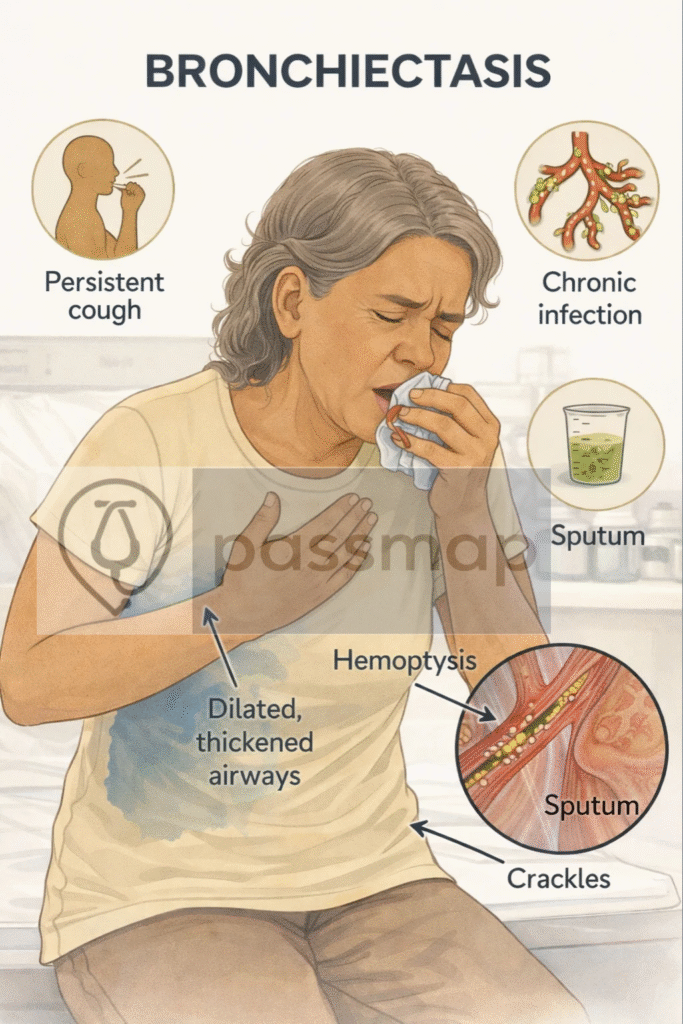
🎯 EXAM ANCHOR – CORE CONCEPT (PARA)

  • Bronchiectasis = irreversible bronchial dilatation
  • Driven by chronic infection and inflammation
  • Hallmark symptom = persistent productive cough
  • Β 

πŸ“Œ PARA commonly asks:

A patient has irreversible airflow obstruction with daily productive cough and recurrent chest infections. What underlying structural abnormality explains this?

πŸ’‘ PARA Differentiation Tip

  • COPD β†’ irreversible airflow obstruction due to smoking-related airway/alveolar damage

  • Bronchiectasis β†’ irreversible airflow obstruction due to structural airway dilatation + sputum

🧠 PARA Memory Trigger

  • β€œWet lungs every day” β†’ think bronchiectasis, not COPD or asthma

πŸ”¬ Pathophysiology

🧠 Mnemonic: CYCLE

  • Chronic infection β†’

  • Yielding inflammation

  • Ciliary damage

  • Loss of airway tone

  • Expansion of bronchi (permanent dilatation)

β†’ Leads to mucus stasis, colonisation, and recurrent infections.

πŸ“‹ Causes

🧠 Mnemonic: ABCD SHIRT

  • Abnormal cilia (e.g. Kartagener’s, PCD)

  • Bronchial obstruction (tumour, foreign body)

  • Cystic Fibrosis

  • Deficiency (immune – IgA, IgG)

  • Systemic disease (RA, IBD, Sjogren’s)

  • Hypersensitivity (ABPA – allergic bronchopulmonary aspergillosis)

  • Infection (childhood measles, TB, pertussis)

  • Reflux/aspiration

  • Tuberculosis or other granulomatous infection

πŸ“‹Clinical Features

🧠 Mnemonic: COUGH SPIT

  • Chronic productive cough

  • Overproduction of sputum (purulent, foul-smelling)

  • Up to 2+ exacerbations per year

  • Green/yellow mucus plugs

  • Haemoptysis (mild to massive)

  • Shortness of breath

  • Pleuritic chest pain

  • Infections recurrent

  • Tiredness (systemic symptoms)

🩺Physical Examination Findings

  • Bilateral coarse crackles Β± wheeze

  • Clubbing

  • Signs of underlying cause (e.g. nasal polyps in CF, rash in vasculitis)

πŸ”¬ Investigation Ladder for Bronchiectasis

1️⃣ First-line Investigations (Initial Assessment)

TestWhy / Exam Notes
CXRMay be normal; tram-track lines, ring shadows
SpirometryObstructive pattern (↓FEV₁, ↓FEV₁/FVC, little/no reversibility). Helps distinguish from asthma.
Sputum cultureEssential before antibiotics. Common bugs: H. influenzae, Pseudomonas, Staph aureus.

🎯 EXAM ANCHOR 2 – ASTHMA / COPD DIFFERENTIATION

  • Asthma β†’ reversible obstruction

  • Bronchiectasis β†’ obstructive pattern with little/no reversibility

  • Chronic productive cough is key discriminator

πŸ“Œ PARA commonly asks:

Which feature best differentiates bronchiectasis from asthma?

2️⃣ Second-line (Diagnostic Confirmation)

TestWhy / Exam Notes
High-resolution CT (HRCT)Gold standard
Β Tram-track sign
Β Signet-ring sign (Internal bronchial diameter > its accompanying pulmonary artery.)
Β Cystic dilatation

🎯 EXAM ANCHOR 3 – DIAGNOSIS (GOLD STANDARD)

  • High-resolution CT (HRCT) = diagnostic gold standard

  • Key CT signs:

    • Tram-track sign

    • Signet-ring sign

    • Cystic bronchial dilatation

  • CXR may be normal and does not exclude bronchiectasis

πŸ“Œ PARA commonly asks:

Which investigation confirms bronchiectasis?

3️⃣ Third Line (Identify Underlying Cause)

TestPurpose
Immunoglobulins (IgA, IgG, IgM)Detect immune deficiency.
Sweat test Β± CFTR geneticsRule out Cystic Fibrosis in young/adult-onset cases.
Aspergillus IgE / precipitinsDiagnoseΒ Allergic Bronchopulmonary Aspergillosis (ABPA)
Autoimmune screen (ANCA, RF)If vasculitis/systemic disease suspected (e.g. GPA, RA, IBD).
HIVIf immunosuppression suspected.

4️⃣ Targeted / Specialist Investigations

TestIndication
BronchoscopyFocal disease β†’ exclude obstruction
Baseline bloodsSafety for long-term therapy

5️⃣ Advanced / Specialist Care

InterventionIndication
Surgical resectionLocalised severe disease
Lung transplantEnd-stage disease

πŸ’Š Management Ladder for Bronchiectasis

1️⃣ First-line (all patients)

InterventionKey Notes
Airway clearance physiotherapyChest physio + postural drainage = cornerstone of management. Daily routine.
Smoking cessation + vaccinationsFlu + pneumococcal essential.
Treat underlying causee.g. stop aspiration, treat immune deficiency, ABPA, CF.

🎯 EXAM ANCHOR 4 – FIRST-LINE MANAGEMENT LONG TERM MANAGEMENT

  • First-line management includes Active Cycle of Breathing Techniques (ACBT) and checking/supplementing Vitamin D levels.

  • Antibiotics alone are not sufficient long-term management

  • Vaccinations + smoking cessation are mandatory supportive care

πŸ“Œ PARA commonly asks:

Most important long-term management strategy in bronchiectasis?

πŸ‘‰ Answer: Airway clearance physiotherapy

2️⃣ During Exacerbation

InterventionKey Notes
14-day antibiotics (oral, guided by sputum culture)Empirical if no result: amoxicillin (or doxycycline/clarithromycin if penicillin-allergic). Pseudomonas β†’ ciprofloxacin.
Sputum culture at each exacerbationGuides therapy + resistance monitoring.

🎯 EXAM ANCHOR 5 – EXACERBATIONS

  • Always send sputum culture before antibiotics

  • Treat exacerbations withΒ 14-day antibiotics

  • If Pseudomonas aeruginosa is isolated for the first-time, NICE recommends eradication therapy (specialist-led) rather than standard symptom management.

πŸ“Œ PARA commonly asks:

Best next step in an acute exacerbation?

3️⃣ Long-term / frequent exacerbators

InterventionKey Notes
Long-term macrolides (azithromycin 3x/week)If β‰₯3 exacerbations/year. Reduces exacerbation frequency.
Inhaled antibiotics (colistin, tobramycin)For chronic Pseudomonas colonisation. Specialist-led.

🎯 EXAM ANCHOR 6 – FREQUENT EXACERBATORS

  • β‰₯3 exacerbations/year β†’ consider long-term macrolide

  • Before starting long-term macrolides (Azithromycin), you must perform:

  • Sputum culture for NTM (Non-Tuberculous Mycobacteria) to prevent resistance.

  • Baseline ECG to check the QTc interval (Macrolides can prolong QTc).

  • Chronic Pseudomonas colonisation β†’ inhaled antibiotics

  • Specialist supervision required

πŸ“Œ PARA commonly asks:

Indication for long-term antibiotics in bronchiectasis?

4️⃣ Adjunctive therapy

InterventionKey Notes
Mucolytics (e.g. carbocisteine)May help sputum clearance.
BronchodilatorsIf asthma/COPD overlap or reversible obstruction.

5️⃣ Specialist referral / advanced care

InterventionIndication
Surgical resection (lobectomy)Rare – for localised, severe, resistant disease.
Lung transplantEnd-stage bronchiectasis with severe respiratory failure.

⚠️ Complications

  • Respiratory failure

  • Massive haemoptysis

  • Pseudomonas colonisation

  • Pulmonary hypertension

  • Cor pulmonale

  • ABPA (allergic bronchopulmonary aspergillosis)

🎯 EXAM ANCHOR 7 – HAEMOPTYSIS (HIGH-RISK TRAP)

  • Mild haemoptysis = common

  • Massive haemoptysis = medical emergency

  • Requires urgent admission Β± interventional radiology

πŸ“Œ PARA commonly asks:

Which complication requires urgent escalation?

🧐Differentials

🧠 Mnemonic: CHAPS

  • COPD

  • Haemoptysis from TB/lung cancer

  • Asthma

  • Pneumonia

  • Sinusitis/post-nasal drip

πŸ”Ž Key PARA Exam Traps

πŸ’‘ HRCT is gold standard β†’ tram-track sign, ring shadows

πŸ’‘ Always send sputum culture, especially in exacerbations

πŸ’‘ Cough + sputum + coarse crackles = high yield

πŸ’‘ Daily chest physio is first-line long term management

πŸ’‘ Long-term abx for frequent exacerbators

πŸ”Ž Last updated in line with NICE NG117 – Bronchiectasis
Published: December 2018 β€’ Last updated: February 2024
Last reviewed: February 2026

πŸ”’ PASSMAP ensures all content is NICE-aligned and reviewed for Physician Associate Registration Assessment (PARA) success.

Β 

Educational platform. Not medical advice.

Β 

Scroll to Top