
📄Definition

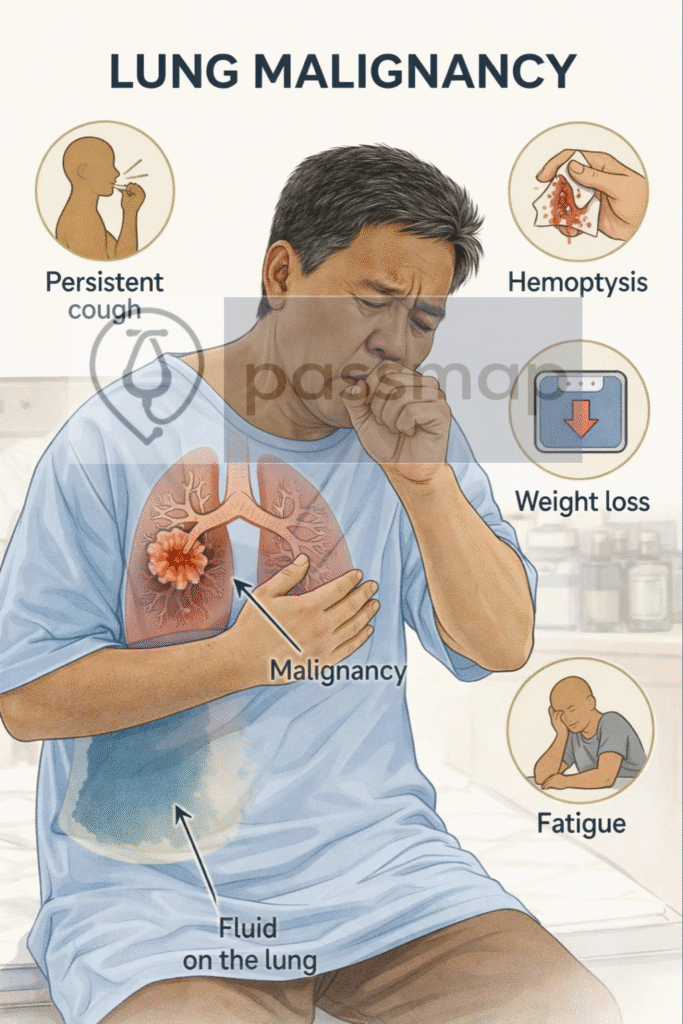
Lung Malignancy is a malignant tumour originating in the lung tissue. It is the leading cause of cancer-related death in the UK.
🎯 EXAM ANCHOR – CORE CONCEPT 

  • Lung malignancy is a malignant tumour of lung tissue

  • Smoking is the strongest risk factor

  • Leading cause of cancer-related death in the UK

📌 PARA commonly asks:

What is the strongest risk factor for lung cancer?

🔬 Pathophysiology

Uncontrolled growth of abnormal lung epithelial cells, often linked to carcinogen exposure (e.g. smoking, asbestos).

Two Main Types:

  • NSCLC (Non-small cell lung cancer – ~85%)
      – Adenocarcinoma (peripheral), squamous cell carcinoma (central), large cell carcinoma

  • SCLC (Small cell – ~15%)
      – Aggressive, early metastasis, strong paraneoplastic links

🎯 EXAM ANCHOR – CANCER TYPES 

  • NSCLC ≈ 85% of cases

  • SCLC ≈ 15%, aggressive with early metastasis

  • Management differs significantly

📌 PARA commonly asks:

Which type of lung cancer accounts for the majority of cases?

📋 Risk Factors

🧠 Mnemonic: CARS SMOKE

  • Chronic lung disease (COPD, ILD)

  • Asbestos exposure

  • Radon gas

  • Secondhand smoke

  • Smoking (most important)

  • Male sex

  • Occupational dusts (arsenic, chromium, silica)

  • Kin history (family)

  • Environmental pollution

📋Clinical Features

🧠 Mnemonic: SPHERE

  • Symptoms: cough (persistent/new/change), dyspnoea

  • Pain: chest pain

  • Haemoptysis

  • Effusion (pleural)

  • Recurring infections (e.g. pneumonia)

  • Energy low (weight loss, fatigue)

🧠 Late signs: hoarseness (recurrent laryngeal nerve), SVC obstruction, clubbing, Horner’s syndrome, bone pain, seizures (mets)

🎯 EXAM ANCHOR – CLINICAL PRESENTATION 

  • Persistent cough

  • Haemoptysis

  • Weight loss

  • Recurrent chest infections

📌 PARA commonly asks:

Which symptom combination should raise suspicion of lung cancer?

Paraneoplastic Syndromes (Especially in SCLC)

🧠 Mnemonic: LEAD

  • Lambert-Eaton (proximal weakness, improves with use)

  • Ectopic ACTH (Cushing’s)

  • ADH → SIADH

  • Dermatological (acanthosis, hypercalcaemia in squamous cell)

🎯 EXAM ANCHOR – PARANEOPLASTIC SYNDROMES 

  • SCLC → SIADH, ectopic ACTH, Lambert–Eaton

  • Squamous cell carcinoma → hypercalcaemia

  • Paraneoplastic features may precede diagnosis

📌 PARA commonly asks:

Which lung cancer is most associated with SIADH?

🔎 Investigations

🧠 Mnemonic: CXR CT PET

  • CXR: 1st-line for persistent cough ≥3 weeks

  • CT thorax with contrast: confirms lesion

  • PET-CT: staging

🎯 EXAM ANCHOR – STAGING 

  • PET-CT used for staging

  • MRI brain if neurological symptoms

  • Staging determines management

📌 PARA commonly asks:

What investigation is required to confirm a diagnosis of lung cancer?

  • Bronchoscopy + biopsy

🎯 EXAM ANCHOR – IMAGING & DIAGNOSIS 

  • CXR = first-line investigation

  • CT chest confirms lesion

  • Tissue biopsy (Histology) required for diagnosis

📌 PARA commonly asks:

What investigation is required to confirm a diagnosis of lung cancer?

  • Sputum cytology

  • EUS/EBUS for central lesions or nodal sampling

  • MRI brain if concern for metastases

  • LFTs – fitness for surgery

🚩Red Flags (2-Week Referral)

Refer if ≥40 with:

  • Haemoptysis

  • Persistent cough or breathlessness

  • Unexplained weight loss

  • Chest pain

  • Hoarseness >3 weeks

  • Finger clubbing

  • Signs of mets (bone, neuro)

🎯 EXAM ANCHOR – METASTATIC FEATURES 

  • Bone pain

  • Neurological symptoms

  • Liver enlargement

  • Supraclavicular lymphadenopathy

📌 PARA commonly asks:

Which clinical finding suggests metastatic lung cancer?

🧾 Management

🧠 Mnemonic: STAGE

  • Surgery – preferred for early-stage NSCLC

🎯 EXAM ANCHOR – SCLC vs NSCLC 

  • SCLC: aggressive, early spread, chemo/radio first-line

  • NSCLC: surgery possible if early-stage

  • SCLC is rarely surgical

📌 PARA commonly asks:

Which type of lung cancer is usually not managed surgically?

  • Targeted therapy – if mutations (e.g. EGFR, ALK)

  • Anti-PD-1 immunotherapy (e.g. pembrolizumab)

  • Guided radiotherapy (SBRT) – non-surgical candidates

  • Etoposide + cisplatin – SCLC chemotherapy backbone

🎯 EXAM ANCHOR – MANAGEMENT PRINCIPLE 

  • Early NSCLC → surgery offers best chance of cure

  • SCLC → chemotherapy ± radiotherapy

  • MDT involvement essential

📌 PARA commonly asks:

Which lung cancer type is most likely to be treated surgically if detected early?

Palliative: chemo/radio, stents, pleurodesis for effusions, pain control

MDT involvement is essential at all stages

📌 PARA Revision Tips

  • Persistent cough + haemoptysis = CXR & 2WW

  • Know paraneoplastic syndromes → high yield

  • CT chest + PET + histology = gold standard

  • SCLC is NOT surgical — usually chemo/radio

  • NSCLC early = surgery best chance

🎯 EXAM ANCHOR – RED FLAGS / 2WW 

  • Haemoptysis in adults ≥40

  • Persistent cough or breathlessness

  • Unexplained weight loss

  • Hoarseness or supraclavicular nodes

📌 PARA commonly asks:

Which symptom mandates an urgent 2-week cancer referral?

🧐Differential Diagnoses

🧠 Mnemonic: PENCIL

  • Pneumonia

  • Empyema

  • Non-malignant mass (e.g. hamartoma)

  • Cryptogenic organising pneumonia

  • Infectious granulomas (TB, fungal)

  • Lung abscess

🔎 Key PARA Exam Traps

💡 Persistent cough, weight loss, haemoptysis = lung cancer until proven otherwise

💡 Normal CXR does NOT exclude lung cancer: High suspicion → urgent CT chest

💡 Smoking is the strongest risk factor, but lung cancer occurs in non-smokers

💡 Hoarseness, Horner’s syndrome, arm pain → think Pancoast tumour

💡 Small cell lung cancer (SCLC) is aggressive and rarely surgical

💡 Non-small cell lung cancer (NSCLC) may be treated surgically if early stage

💡 SIADH, hypercalcaemia, Cushing’s = paraneoplastic syndromes (exam favourite)

💡 Supraclavicular lymphadenopathy strongly suggests malignancy

💡 Unexplained recurrent “pneumonia” in the same lobe → suspect obstruction by tumour

💡 Always consider metastatic disease: Bone pain, neurological symptoms, liver enlargement

🔎Last updated in line with NICE NG122 – Lung Cancer
Published: March 2019 • Last updated: February 2024

  • PARA-aligned, reviewed February 2026


🔒PASSMAP ensures all content is NICE-aligned and reviewed for Physician Associate Registration Assessment (PARA) success.

Scroll to Top