
5.1. Pneumonia (CAP & HAP)

πŸ“„ Definition

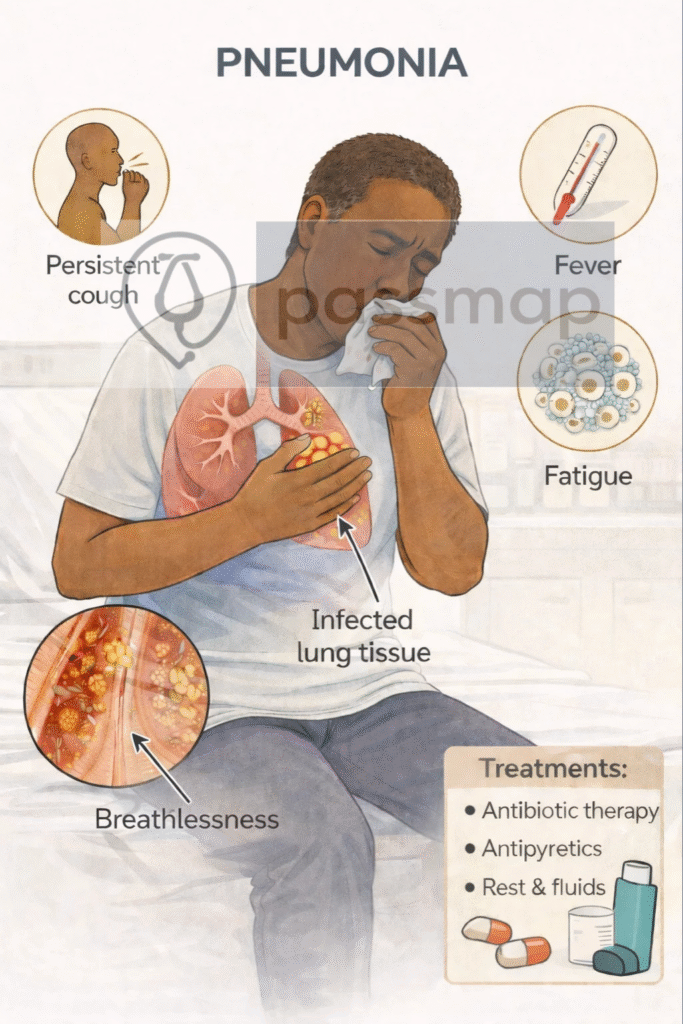
Pneumonia is an acute infection of the lung parenchyma causing consolidation, typically with cough, fever, and breathlessness.

🎯 EXAM ANCHOR – CORE CONCEPT (PARA)

  • Pneumonia = acute infection of lung parenchyma

  • Causes consolidation and impaired gas exchange

  • Presents with cough, fever, breathlessness

πŸ“Œ PARA commonly asks:

What is pneumonia?

Types include:

  • CAP – Community-Acquired Pneumonia

  • HAP – Hospital-Acquired Pneumonia (onset β‰₯48 hours after admission)

🎯 EXAM ANCHOR – CAP vs HAPΒ 

  • CAP β†’ onset in the community

  • HAP β†’ onset β‰₯48 hours after hospital admission

  • Classification is based on timing, not organism

πŸ“Œ PARA commonly asks:

How is hospital-acquired pneumonia defined?

Mnemonic: LUNG INFECTION

Lobar or Unilateral
New infiltrates on imaging
Green/yellow sputum
Infection signs (fever, ↑CRP)
Neutrophilia
Fatigue
Elevated RR
Confusion (elderly)
Tachycardia
Inspiratory crackles
Overexertion breathlessness
Night sweats Β± pleuritic pain

🎯 EXAM ANCHOR – ELDERLY PRESENTATION (PARA)

  • Elderly may present atypically

  • Confusion, falls, or functional decline may be the main feature

πŸ“Œ PARA commonly asks:

How may pneumonia present differently in elderly patients?

Pathophysiology
  • Inhalation of microbes (e.g. Streptococcus pneumoniae)
    β†’ alveolar inflammation
    β†’ capillary leak + exudate
    β†’ consolidation and impaired gas exchange

πŸ›‘οΈCauses (Aetiology)

Mnemonic: “B-FIT”

  • Bacterial – S. pneumoniae, H. influenzae, Legionella

  • Fungal – Aspergillosis, Pneumocystis jirovecii

  • Influenza viruses – Influenza A/B, RSV, COVID-19

  • Tuberculosis – M. tuberculosis (airborne)

Risk Factors

Mnemonic: SPLASH
Smoking
Pre-existing lung disease (COPD, asthma)
Low immunity (HIV, diabetes, cancer)
Age extremes (elderly, infants)
Steroids or immunosuppressants
Hospitalisation (for HAP)

πŸ€’Clinical Features

Mnemonic: COPS
Cough (productive Β± blood-streaked)
Over 38Β°C fever
Pleuritic chest pain
Shortness of breath

Others: rigors, confusion (elderly), fatigue

Diagnosis

  • CXR = gold standard

  • FBC: neutrophilia

  • CRP, U&Es (for CRB65)

  • Blood cultures (if severe)

  • Sputum culture Β± Legionella/pneumococcal urinary antigens

  • Oβ‚‚ sats (ABG if <92%)

🎯 EXAM ANCHOR – DIAGNOSISΒ 

  • Chest X-ray confirms pneumonia

  • Clinical features alone are insufficient

  • Normal early CXR does not exclude pneumonia

πŸ“Œ PARA commonly asks:

A patient presents with fever, cough, and pleuritic chest pain. Which investigation is required to confirm the diagnosis of pneumonia?

CXR Findings

Mnemonic: ABC of Consolidation
Air bronchograms
Bronchial wall thickening
Confluent opacity (lobar or patchy)

Lobar: homogeneous, sharp borders
Bronchopneumonia: multifocal, patchy
Aspiration: often lower zone, right lung

🎯 EXAM ANCHOR – ASPIRATION PNEUMONIA (PARA)

  • Occurs in dependent lung zones

  • Right lower lobe commonly affected

  • Risk factors: reduced consciousness, stroke, dysphagia

πŸ“Œ PARA commonly asks:

Which lung zone is most commonly affected in aspiration pneumonia?

Severity Assessment – CRB65 Score (NICE)

Mnemonic: CRB65
Confusion (AMTS ≀8)
Respiratory rate β‰₯30
Blood pressure (SBP <90 or DBP ≀60)
65 years or older

ScoreRiskAction
0LowHome treatment Β± PO antibiotics
1–2ModerateHospital referral
β‰₯3HighUrgent hospital admission Β± ITU review

🎯 EXAM ANCHOR – SEVERITY (CAP)Β 

  • CRB-65 / CURB-65 assess severity, not diagnosis

  • Guides site of care decision

πŸ“Œ PARA commonly asks:

Which score is used to assess severity in community-acquired pneumonia?

CRB65 is used in the community; CURB-65 is used in hospital settings where urea is available.

Management

➀ CAP

Mnemonic: CAP DOC
CRB65 (or CURB-65 if urea available) guides location of care
Amoxicillin 500 mg TDS 5 days (mild)
Penicillin allergy β†’ doxycycline or clarithromycin
Dual therapy (amoxicillin + macrolide) if moderate/severe
Oxygen + fluids if needed
CXR repeat in 6 weeks if red flags (e.g. smoker, >50yrs)

➀ HAP

  • Within 5 days: cover Gram-positive + typicals

  • After 5 days: cover Gram-negative + resistant bugs
    e.g. co-amoxiclav or piperacillin-tazobactam

🎯 EXAM ANCHOR – MANAGEMENT PRINCIPLE

    • CAP antibiotics guided by severity

    • HAP requires broader cover (Gram-negative Β± resistant organisms)

    • Start antibiotics promptly after cultures (if indicated)

πŸ“Œ PARA commonly asks:

Why does HAP require broader antibiotic coverage than CAP?

Monitoring & Follow-Up

  • Oβ‚‚ sats, RR, temp, HR

  • Check CRP, WCC, and U&Es

  • Repeat CXR after 6 weeks if:
    smoker
    >50 yrs
    slow resolution
    lobar consolidation

🎯 EXAM ANCHOR – TREATMENT FAILURE

  • No improvement at 48–72 hours β†’ reassess
  • Consider:

    • Wrong diagnosis

    • Resistant organism

    • Complication (e.g. empyema)

πŸ“Œ PARA commonly asks:

What should be considered if pneumonia does not improve after 48–72 hours of treatment?

Complications

Mnemonic: LIES
Lung abscess
Infection spread (empyema, sepsis)
Effusion (parapneumonic or empyema)
Scarred lung (fibrosis, bronchiectasis)

Differential Diagnoses

Mnemonic: PALM PECS
Pulmonary embolism
Asthma/COPD exacerbation
Lung cancer
Myocardial infarction
Pleural effusion
Eosinophilic pneumonia
COVID-19
Sarcoidosis

πŸ”Ž Key PARA Exam Traps

πŸ’‘ CAP vs HAP is defined by timing, not organism: CAP = community onset; HAP = β‰₯48 hours after admission

πŸ’‘ CURB-65 guides CAP severity, not diagnosis: Score β‰₯2 β†’ consider admission; β‰₯3 β†’ severe CAP

πŸ’‘ CRP and WCC are non-specific: Use to support infection, not to identify pathogen

πŸ’‘ CXR confirms pneumonia: Clinical features alone are insufficient

πŸ’‘ Normal early CXR does not exclude pneumonia: Repeat imaging if high clinical suspicion

πŸ’‘ Send sputum cultures before antibiotics in severe CAP or HAP

πŸ’‘ HAP requires broader antibiotic cover: Think Gram-negative organisms and MRSA risk

πŸ’‘ Failure to improve at 48–72 hours β†’ reassess diagnosis, complications, or resistance

πŸ’‘ Aspiration pneumonia β†’ dependent lung zones; risk factors include stroke and reduced consciousness

πŸ’‘ Elderly patients may present atypically: Confusion or falls may be the main feature

Last updated in line with NICE NG138 (October 2019)

  • PARA-aligned, reviewed February 2026

PASSMAP ensures all content is NICE-aligned and exam-optimised for the Physician Associate Regulation Assessment (PARA).

Educational platform. Not medical advice.

Scroll to Top