
3.1. Peripheral Arterial Disease (PAD)

πŸ“„ Definition

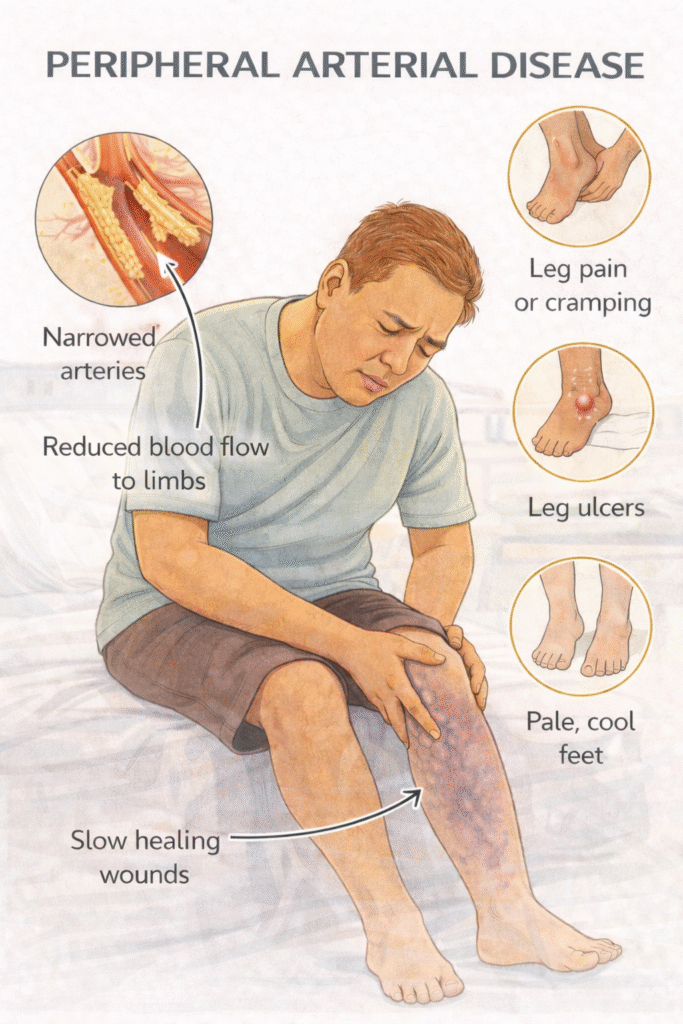
Peripheral arterial disease (PAD) is a manifestation of systemic atherosclerosis causing stenosis or occlusion of arteries, primarily affecting the lower limbs. It ranges from asymptomatic disease to critical limb ischaemia.

⚠️ Classification

  • Asymptomatic PAD: reduced pulses, ABPI <0.9 but no symptoms

  • Intermittent Claudication: reproducible leg pain with exertion, relieved by rest

  • Critical Limb Ischaemia (CLI): chronic pain at rest, ulceration, or gangrene

πŸ›‘οΈ Risk Factors – Mnemonic: ATHEROSE

  • Age >60

  • Tobacco use (most significant modifiable)

  • Hypertension

  • Elevated cholesterol

  • Renal impairment (CKD)

  • Obesity

  • Sedentary lifestyle

  • Endocrine: Diabetes mellitus

InvestigationsΒ 

πŸ₯‡ First-Line

  • ABPI (Ankle-Brachial Pressure Index):

    • <0.9 = diagnostic of PAD

    • <0.5 = severe disease

  • Duplex Doppler Ultrasound – assess blood flow and stenosis
🎯 EXAM ANCHOR 1 – THE ABPI INTERPRETATION

  • The Ankle-Brachial Pressure Index (ABPI) is your first-line diagnostic test.

    • Normal: 1.0 – 1.2

    • PAD: < 0.9

    • Critical Limb Ischaemia: < 0.5 (or ankle pressure < 50 mmHg)

    PARA TRAP – The Calcified Vessel: In patients with Diabetes or CKD, arteries can become calcified and non-compressible. This leads to a falsely high ABPI (> 1.2). If you see a high ABPI in a symptomatic diabetic, the next step is a Toe-Brachial Pressure Index (TBPI) or Duplex Ultrasound.

πŸ₯ˆ Second-Line

  • MR Angiography or CT Angiography – pre-intervention planning

  • Bloods: FBC, U&Es, HbA1c, Lipids, LFTs, ESR/CRP

  • ECG – evaluate cardiovascular risk

πŸ“‹ Clinical Features – 

Mnemonic: 6 Ps (acute) and CLAUDICATE (chronic)
Acute Limb Ischaemia – 6 Ps:
  • Pain

  • Pallor

  • Pulselessness

  • Paralysis

  • Paraesthesia

  • Perishing cold

Chronic PAD – Mnemonic: CLAUDICATE

  • Cramping calf pain

  • Loss of hair

  • Abnormal pulses

  • Ulcers (arterial)

  • Dry, shiny skin

  • Intermittent claudication

  • Cool peripheries

  • ABPI <0.9

  • Toe pallor

  • Erectile dysfunction (Leriche syndrome)

🎯 EXAM ANCHOR 1 – CHRONIC VS. ACUTE FEATURES

  • Intermittent Claudication: Pain is reproducible (occurs at the same distance every time) and relieved by rest.

  • Critical Limb Ischaemia (CLI): Defined by the “Triad of Trouble”:

  1. Rest Pain: Burning pain at night, relieved by hanging the leg over the edge of the bed (gravity helps perfusion).

  2. Ulceration: Typically “punched out” ulcers on the toes or heels.

  3. Gangrene.

Management – Mnemonic: PAD CARE

  • Prevention – smoking cessation, weight reduction, exercise

  • Antiplatelet – clopidogrel first-line

  • Dual risk factor control – manage BP, lipids, diabetes

  • Cilostazol (for symptom relief in intermittent claudication)

  • Angioplasty or stenting – severe symptoms or CLI

  • Revascularisation – surgical bypass if angioplasty not feasible

  • Education – foot care, PAD risk understanding

🎯 EXAM ANCHOR 1 – MANAGEMENT (NICE CG147)

  • The PARA tests your ability to prioritize medical management before jumping to surgery.

  1. Antiplatelet: Clopidogrel 75mg is the first-line choice (Aspirin is second-line for PAD).
  2. Statin: Atorvastatin 80mg (High-intensity) for all patients.
  3. Supervised Exercise Programme: This is the first-line non-drug treatment for intermittent claudication. Patients should walk until the pain is near-maximal, then rest, then repeat for 30–45 mins, 3x per week.
  4. Naftidrofuryl oxalate: If exercise and risk factor modification fail, this can be offered for symptom relief (NICE alternative to Cilostazol).
  5. Β 

⚠️ Complications

  • Critical limb ischaemia

  • Amputation

  • Ulceration

  • Cardiovascular morbidity (MI, stroke)

πŸ”Ž Key PARA Exam Traps

  • Buerger’s Test: Raising the leg causes it to go pale (pallor), and lowering it causes it to turn a deep red (reactive hyperaemia). This is a classic sign of severe ischaemia.

  • Foot Care: Diabetic patients with PAD need referral to a Podiatrist. Even a small nick during a nail trim can lead to a non-healing ulcer and amputation.

  • Beta-Blockers: There is an old myth that Beta-blockers are contraindicated in PAD. NICE states they are safe to use if needed for other conditions, though they may rarely worsen symptoms in some patients.

πŸ”Ί Last updated in line with NICE CG147 – Peripheral arterial disease: diagnosis and management

Published: August 2012 β€’ Last updated: October 2020

  • PARA-aligned, reviewed February 2026


βœ… PASSMAP ensures all content is NICE-aligned and reviewed for Physician Associate Registration Assessment (PARA) success.

Educational platform. Not medical advice.

Scroll to Top