
4. Cystic Fibrosis (CF)

📄Definition

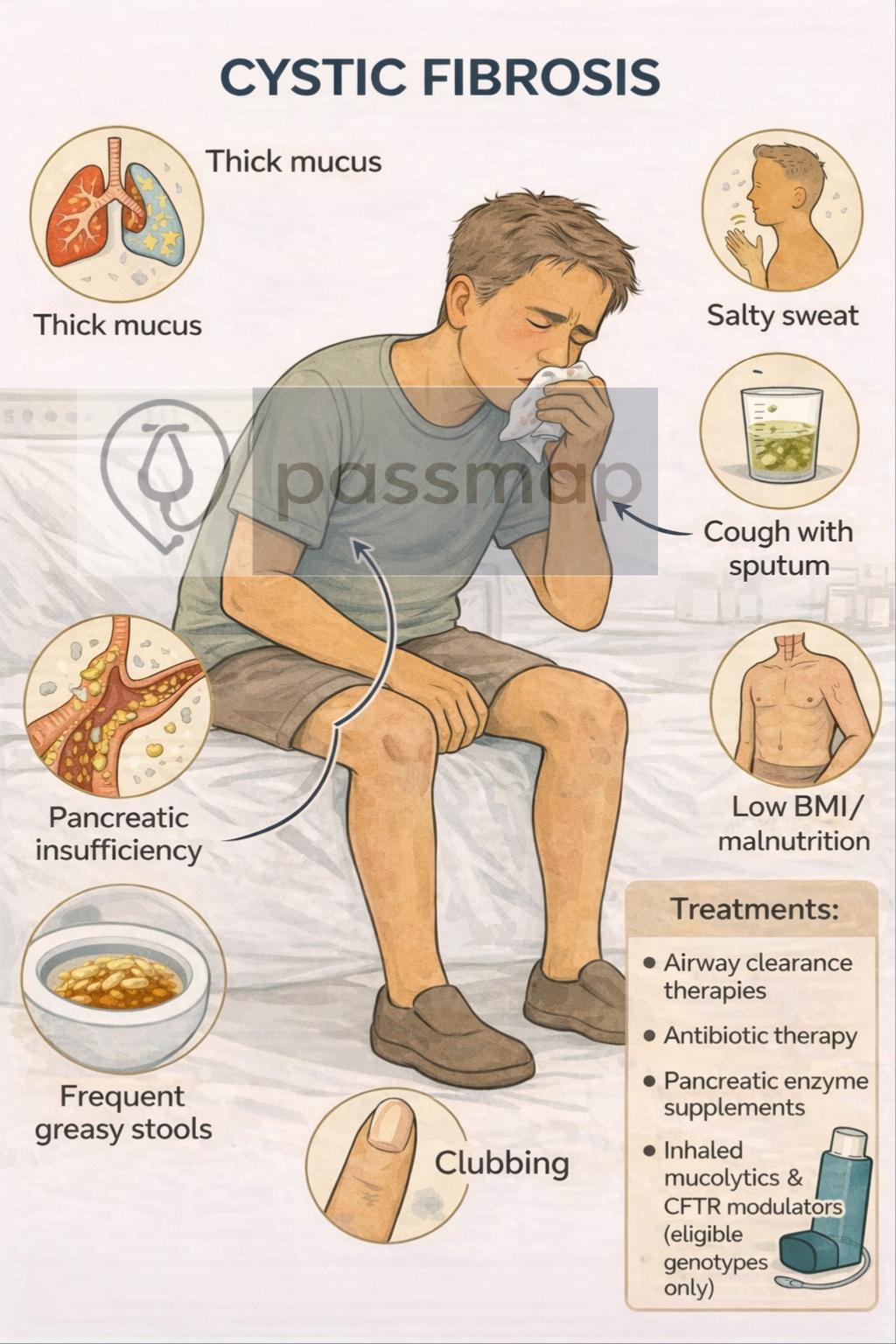
Cystic Fibrosis is an autosomal recessive genetic disorder caused by mutations in the CFTR gene, leading to defective chloride transport and production of thick, sticky secretions affecting the lungs, pancreas, gastrointestinal tract, and reproductive system.

🎯 EXAM ANCHOR – CORE CONCEPT (PARA) 

  • CF = autosomal recessive CFTR mutation
  • Defective chloride transport → thick, sticky secretions
  • Multisystem disease (lungs, pancreas, GI, reproductive)
  •  

📌 PARA commonly asks:

Which genetic disorder causes thick, sticky secretions due to CFTR dysfunction?
🎯 EXAM ANCHOR – INHERITANCE

  • Autosomal recessive inheritance

  • Both parents must be carriers

  • Siblings at increased risk

📌 PARA commonly asks:

What is the mode of inheritance of cystic fibrosis?

🩺 Physical Examination Findings

  • Chronic productive cough
  • Coarse crackles ± wheeze
  • Finger clubbing

Signs of advanced disease:

  • Pulmonary hypertension

  • Cor pulmonale

🎯 EXAM ANCHOR – RESPIRATORY MANIFESTATIONS 

  • Chronic productive cough

  • Recurrent chest infections

  • Bronchiectasis develops over time (irreversible)

📌 PARA commonly asks:

Which chronic lung complication commonly develops in cystic fibrosis?

🔎 Investigations

🧠 Mnemonic: SWEEP BUGS

S — Screening (Most Common Initial)

  • Newborn blood spot (Guthrie/heel-prick) test measuring immunoreactive trypsinogen (IRT).

    Confirmatory (gold standard): Sweat chloride test — a result >60 mmol/L confirms cystic fibrosis.

    Genetic testing: Used when the sweat chloride result is intermediate (30–59 mmol/L) or to identify specific CFTR mutations (e.g. F508del) for CFTR modulator eligibility.

W — Whole CFTR genetic testing

    • Confirms mutation

    • Determines CFTR modulator eligibility

🎯 EXAM ANCHOR – DIAGNOSIS

📌 PARA commonly asks:

What is the gold standard diagnostic test for cystic fibrosis?

E — Exocrine pancreatic function

    • Faecal elastase ↓

    • Explains steatorrhoea & malnutrition

E — Exercise oxygen saturation

    • Desaturation in advanced disease

P — Pulmonary function tests

    • Obstructive pattern

    • Progressive ↓ FEV₁ over time

B — Bronchiectasis on High-Resolution Computed Tomography (HRCT) 

  • Dilated airways

  • Mucus plugging

  • Tree-in-bud opacities

🎯 EXAM ANCHOR – IMAGING (PARA)

  • Sweat chloride test = diagnostic gold standard

  • Elevated sweat chloride confirms CF

  • Genetic testing supports diagnosis

📌 PARA commonly asks:

📌 What is the typical HRCT chest finding in cystic fibrosis?

👉 Answer: Bronchiectasis with mucus plugging

U — Upper GI / neonatal history

  • Meconium ileus in neonates (highly suggestive of CF)

G — Glucose testing

  • Screen for CF-related diabetes

S — Sputum cultures

  • Identify colonising organisms

  • Pseudomonas aeruginosa most common

🎯 EXAM ANCHOR – MICROBIOLOGY

📌 PARA commonly asks:

  • Commonest organism in children: Staphylococcus aureus (often managed with prophylactic Flucloxacillin). Commonest in adults: Pseudomonas aeruginosa.”

Which organism in adults is most commonly colonises the lungs in cystic fibrosis?

👉 Answer: Pseudomonas aeruginosa

🧾 Management

🧠 Mnemonic: CLEAN AIRWAYS

Chest physiotherapy

    • Daily airway clearance is essential

    • Cornerstone of long-term management

🎯 EXAM ANCHOR – MANAGEMENT PRINCIPLE 

  • Daily airway clearance is essential

  • Long-term multidisciplinary specialist care required

📌 PARA commonly asks:

What is the cornerstone of long-term respiratory management in cystic fibrosis?

  • Other Key Management Components

    • Long-term antibiotics (e.g. azithromycin)

    • Pancreatic enzyme replacement (Creon)

    • High-calorie, high-protein diet

    • Nebulised bronchodilators + mucolytics (e.g. DNase)

    • Antibiotics for exacerbations (oral/IV guided by culture)

    • Annual screening for CF-Related Diabetes (CFRD) from age 10 using an Oral Glucose Tolerance Test (OGTT).

    • Note: HbA1c is not recommended for diagnosis in CF)

    • Oxygen / NIV if progressive disease

    • Vaccinations (annual flu, pneumococcal)

    • Smoking avoidance

    • Specialist multidisciplinary CF team care

🎯 EXAM ANCHOR – PANCREATIC INVOLVEMENT

  • Pancreatic insufficiency is common

  • Causes steatorrhoea & weight loss

  • Requires enzyme replacement

📌 PARA commonly asks:

What causes steatorrhoea and weight loss in cystic fibrosis?

CFTR Modulators (e.g. ivacaftor, lumacaftor–ivacaftor) for eligible genotypes
Lung transplant in end-stage disease

🎯 EXAM ANCHOR – TARGETED THERAPY 

  • CFTR modulators (e.g. ivacaftor, lumacaftor–ivacaftor)

  • Target the underlying CFTR defect

  • Only effective in eligible genotypes

📌 PARA commonly asks:

Which therapy targets the underlying CFTR defect in cystic fibrosis?

⚠️ Complications

  • Bronchiectasis

  • Respiratory failure

  • Infertility (especially males)

  • CF-related diabetes

  • Osteoporosis

  • Liver disease

  • Intestinal obstruction

  • Pneumothorax

  • Haemoptysis

  • Psychological impact

🎯 EXAM ANCHOR – FERTILITY 

  • Male infertility is common

  • Due to congenital absence of the vas deferens

📌 PARA commonly asks:

What reproductive complication commonly affects males with cystic fibrosis?

🧐Differentials

🧠 Mnemonic: SAME FAIL

  • Severe asthma

  • Allergic bronchopulmonary aspergillosis (ABPA)

  • Meckel’s diverticulum (if bowel obstruction)

  • Enteropathy

  • Foreign body inhalation

  • Alpha-1 antitrypsin deficiency

  • Immunodeficiency

  • Lung malformations

📌 PARA Revision Tips

  • Gold standard test = sweat chloride

  • Most common bug = Pseudomonas aeruginosa

  • Know Creon, airway clearance, and CFTR modulator therapy

  • Meconium ileus in newborns = suspect CF

  • Discuss genetic inheritance and screening

🔎 Key PARA Exam Traps – Cystic Fibrosis (CF)

💡 Autosomal recessive CFTR mutation → thick, sticky secretions

💡 Gold standard test = sweat chloride (↑ chloride)

💡 Most common respiratory pathogen = Pseudomonas aeruginosa

💡 Chronic lung disease → bronchiectasis (not reversible)

💡 Pancreatic insufficiency → steatorrhoea → treat with Creon

💡 Male infertility common (congenital absence of vas deferens)

💡 Meconium ileus in neonates = CF until proven otherwise

💡 CF-related diabetes is common 

💡 Daily airway clearance is core management, not optional

💡 CFTR modulators only work for eligible genotypes

🧪 The “Must-Know” PARA Numbers for CF

Factor PARA / NICE Standard
Sweat Test Chloride > 60 mmol/L
Diabetes Screen OGTT (not HbA1c) annually from age 10
Inheritance Autosomal Recessive (25% chance if both parents are carriers)
Microbiology S. aureus (Child) → P. aeruginosa (Adult)
The “Social” Rule Patients with CF must never meet in person (risk of cross-infection with Burkholderia cepacia).

🔎 Last updated in line with NICE NG78 (2017), reviewed 2023
Last reviewed: February 2026
🔒 PASSMAP ensures all content is NICE-aligned and reviewed for Physician Associate Registration Assessment (PARA) success.

Educational platform. Not medical advice.


Scroll to Top